
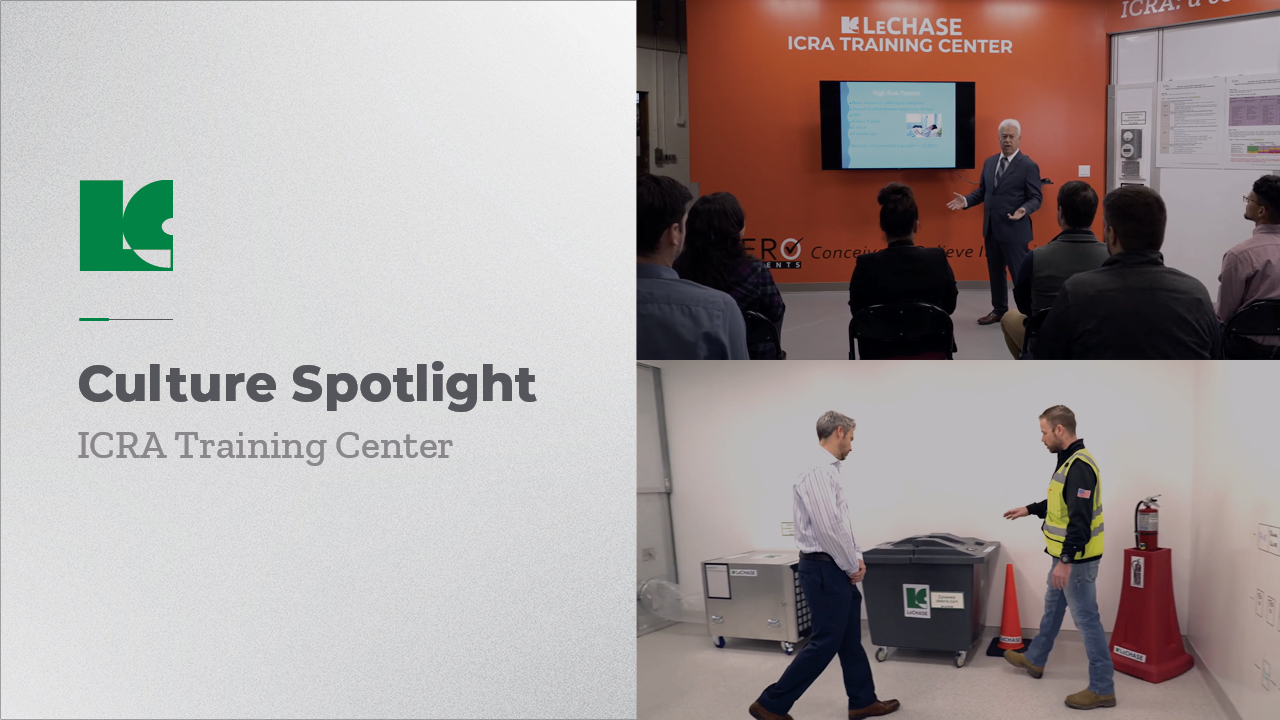
ICRA Training Center

Addressing ICRA: Why and How

Often, healthcare facilities remain open during projects and improvements. The work can generate harmful dust like Aspergillus – a fungal mold spore that can be life threatening, especially to the immune compromised, the elderly and other high-risk patients.

Maintaining a safe environment requires assessing each situation and enacting the necessary prevention measures based on the type of work and areas where work is occurring.
Creating an ICRA Plan

Before any project, a multidisciplinary team (Project Manager, Infection Prevention & Control, Environmental Health & Safety) completes the Infection Control Risk Assessment (ICRA) to determine the specific measures needed. LeChase can guide clients through the multi-step evaluation process.

The Four-Step Evaluation

1

Rate the amount of dust and disruption a project will create – using a scale from A (non-invasive efforts like inspections or painting) to D (demolition or new construction).
2

Rate risk – given the type of site – on a scale from low (e.g., offices) to highest (e.g., ICUs, sterile processing areas).
3


Use the ICRA Matrix to determine the Class (I, II, III, IV or V). This defines the needed precautions (from simple cleaning to full containment and worker controls) as well as any permits or formal inspections required. The team will also evaluate presence of any environmental hazards (mold, asbestos, etc.) that would automatically escalate a project to Class IV or V.

4

Assess areas (below, above, adjacent) surrounding the project and determine additional controls to address dust as well as noise, vibration, ventilation, pressurization, system impacts, etc.
Step 3 - Determine Class of Precautions

ICRA Matrix

Match the construction activity type with the patient risk group to determine the required Class of Precautions.

Patient Risk Group
Construction Project Type
Type A Type B Type C Type D
LOW I II II III*
MEDIUM I II III* IV
HIGH I III IV V
HIGHEST III IV V V

* Denotes elevated review requirements within this classification level.

Risk Level Key
Level I — Low
Level II — Moderate
Level III — Elevated
Level IV — High
Level V — Critical
Step 3 - Determine Class of Precautions

ICRA Matrix

Match the construction activity type with the patient risk group to determine the required Class of Precautions.

Patient Risk Group
Construction Project Type
Type A Type B Type C Type D
LOW I II II III*
MEDIUM I II III* IV
HIGH I III IV V
HIGHEST III IV V V

* Denotes elevated review requirements within this classification level.

Risk Level Key
Level I — Low
Level II — Moderate
Level III — Elevated
Level IV — High
Level V — Critical

The Four-Step Evaluation

1

Rate the amount of dust and disruption a project will create – using a scale from A (non-invasive efforts like inspections or painting) to D (demolition or new construction).
2

Rate risk – given the type of site – on a scale from low (e.g., offices) to highest (e.g., ICUs, sterile processing areas).
3


Use the ICRA Matrix to determine the Class (I, II, III, IV or V). This defines the needed precautions (from simple cleaning to full containment and worker controls) as well as any permits or formal inspections required. The team will also evaluate presence of any environmental hazards (mold, asbestos, etc.) that would automatically escalate a project to Class IV or V.

4

Assess areas (below, above, adjacent) surrounding the project and determine additional controls to address dust as well as noise, vibration, ventilation, pressurization, system impacts, etc.

Creating an ICRA Plan

Before any project, a multidisciplinary team (Project Manager, Infection Prevention & Control, Environmental Health & Safety) completes the Infection Control Risk Assessment (ICRA) to determine the specific measures needed. LeChase can guide clients through the multi-step evaluation process.

Enacting Prevention Measures

Given the needs identified using the ICRA matrix, teams can enact a variety of prevention measures across several broad categories.

Job Site Containment


  • Physical barriers (plastic sheeting, sheetrock, zipper doors, etc.) to isolate the work area
  • HEPA-filtered exhaust fans to maintain negative air pressure – ensuring air flows into the construction zone or outdoors away from intakes vs. into patient areas.
  • Sealing HVAC air intakes/returns, supply diffusers, windows, doors and vents.
  • An anteroom for staging, cleaning and decontamination

Materials/Debris Management

  • Covered, nonporous containers for trash
  • Damp-wiping containers before they leave the containment area
  • Approved transport routes

Worker/Material Controls

  • Requiring clean clothing/coveralls and shoe covers
  • Sticky mats to clean shoes
  • HEPA vacuum to clean clothing after work
  • Hand washing with soap and water (15 seconds) or alcohol-based hand gel

Post-job Cleanup

 
  • Thorough cleaning of all surfaces (HEPA vacuum or damp mop)
  • Removing barriers (only after cleaning is complete)
  • Inspecting HVAC registers and diffusers for dust
  • Restoring/verifying HVAC systems operate to original specifications.

Book a Training!

Name

Book a Training!

Build your skills and confidence in infection control risk assessment with LeChase’s ICRA Training Center. Book your training today and join professionals committed to safe, high-quality construction environments.